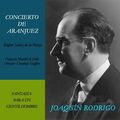
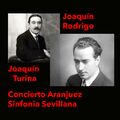
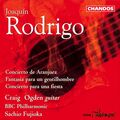
His best-known work, the Aranjuez Concerto, is a firm favorite with the public, and remains a must for every classical guitarist. Joaquín Rodrigo Vidre, 1st Marquis of the Gardens of Aranjuez, was born in Sagonte in the province of Valencia, Spain, on November 22, 1901. The youngest of ten children born to Vicente Rodrigo Peirats, a landowner from Almenara, he was struck down at the age of three by a diphtheria epidemic that left him virtually blind for life. To enable him to attend a specialized school, the family moved to Valencia. Attracted by music, he attended concerts and operas at the Apollo Theater, where his parents were regulars, and took his first lessons in music theory, violin and piano. He then entered the Valencia Conservatory, where his teachers from 1917 to 1922 included Francisco Antich, Enrique Gomá and Eduardo López-Chávarri, a pianist and musicologist who was a pioneer of Spanish modernism. At home, his education continued with Rafael Ibáñez, who became his reader, personal secretary and copyist for the layout of scores, as the young Joaquín Rodrigo, who wrote his works in Braille, was soon composing. In 1923, a Suite for piano, Two Sketches for violin and piano and a Cançoneta for violin and orchestra were soon followed by a symphonic essay, Juglares and Cinco piezas infantiles, for orchestra, which won second prize in the 1925 National Composition Competition. The following year saw the birth of his first composition for guitar, Zarabanda lejana, and a Preludio al gallo mañanero for piano. In 1927, Rodrigo went to Paris to study with Paul Dukas at the École normale de musique until 1932, where he immersed himself in artistic life, meeting Maurice Ravel, Darius Milhaud, Arthur Honegger, Igor Stravinsky and his compatriots Ricardo Viñes and Manuel de Falla. He also met the Turkish pianist Victoria Kamhi, whom he married on January 19, 1933, and who gave him a daughter named Cecilia in 1941. Continuing to compose, Rodrigo expanded his repertoire with a Siciliana for cello and piano (1929) and an orchestral suite Zarabanda lejana y Villancico (1930). He continued his Parisian studies at the Sorbonne Conservatoire, and in 1934 delivered Cántico de la esposa, for voice, piano and orchestra, and the symphonic poem Per la flor del lliri blau. On learning of Dukas's death in 1935, he dedicated the Sonata de adiós for piano to him. As civil war broke out in Spain, he continued his travels in Germany, Switzerland and Austria, before finally returning to Spain in 1939 with the manuscript of the Aranjuez Concerto for guitar and orchestra, a feat as much as a rarity at the time. The work, written as a tribute to the gardens of the Royal Palace of Aranjuez where the couple spent their honeymoon, was given its world premiere on November 9, 1940 at the Palau de la Música Catalana in Barcelona, by guitarist Regino Sáinz de la Maza and the Barcelona Philharmonic Orchestra conducted by César Mendoza Lasalle. It has given rise to numerous interpretations by leading classical guitarists such as Andrés Segovia and Narciso Yepes, as well as adaptations including the famous one by jazz trumpeter Miles Davis with arranger Gil Evans on the album Sketches of Spain (1960). His central Adagio has been the subject of numerous versions, often sung, throughout the world. The composer continued to write works of great value for the string instrument, such as Fantaisía para un gentilhombre (1954), Concerto Andaluz for four guitars and orchestra (1967), Concerto Madrigal for two guitars and orchestra (1966) and Concerto para una fiesta (1982), but he decided not to devote himself to this genre and diversify his output with a wide variety of pieces. In 1943, he won an award for Concierto heroico for piano and orchestra, premiered by Leopoldo Querol. A work so difficult to tackle that it required a revision by Joaquín Achúcarro in 1996. Also dating from 1943 is Concierto de estio for violin and orchestra, followed by Capriccio for violin and Ausencias de Dulcinea, for baritone and four sopranos (1948), which won first prize in the competition commemorating the birth of Cervantes. The following year saw the birth of Concerto in modo galante, for cello and orchestra, and in 1954, Concerto serenata for harp and orchestra, commissioned by soloist Nicanor Zabaleta. Numerous short pieces for solo guitar followed in the decades that followed, including Triptico (1978), dedicated to Alexandre Lagoya. Joaquin Rodrígo's work is extremely prolific, if we consider that, due to his handicap, each composition has to be detailed note by note by the copyist, who transcribes it onto a score played on the piano by Victoria Kamhi, so that it can be approved by the composer before being sent to a publisher. Rodrigo was also director of the music department at Spain's national radio station, and since 1939 has held the Manuel de Falla chair of music at Madrid University. He has received numerous academic and honorary awards, including the Gold Medal of the Royal Conservatory of Madrid (1995), Commandeur de l'Ordre des Arts et des Lettres in France (1998), and the Prize for Best Classical Music Author from the SGAE (Société générale des auteurs et éditeurs, 1998). In 1991, he was awarded the title of Marquis of the Gardens of Aranjuez by King Juan Carlos I, and in 1996, the Prince of Asturias Prize. Two years after his wife's death on July 21, 1997, Joaquín Rodrigo died in Madrid on July 6, 1999.