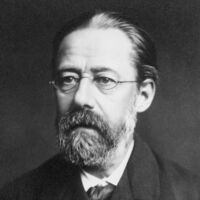
Associated with La Moldau, the symphonic poem from the Má Vlast(My Homeland) cycle, Smetana was the first of the great Czech composers. When he was born in Litomyšl on March 2, 1824, his native Bohemia was part of the Austrian Empire. The son of a wealthy brewer and musician in a string quartet, František Smetana introduced him to the violin and, from the age of five, had him take piano lessons from a local teacher, Jan Chmelík. At just six years of age, little Smetana performed a piece in public at the Academy, before beginning to compose short pieces. In 1831, the family moved to Jindřichův Hradec (Neuhaus), where the child continued his musical studies with František Ikavec, who also taught him to sing. Wounded in the right cheek during a game with a bottle of gunpowder, he retained the after-effects of a facial asymmetry for the rest of his life, which he later hid under a beard. After a year in Jihlava (Iglau) and three at the grammar school in Německý Brod (Deutschbrod), he continued his studies in Prague in 1839, where he attended concerts by Franz Liszt. Smetana was destined for a musical career, despite his father's reservations, who sent him to Pilsen, where his cousin was a teacher, only to leave in 1843, having composed the Louisen-Polka for his cousin, among other dance pieces, early orchestral works and piano impromptus. Against his father's advice, he returned to Prague and joined the Concordia artistic company, where he met the conservatory's director, Jan Bedřich Kittl, who found him pupils in the children of Count Leopold Thun, who was to become one of his supporters. From 1844, he studied composition for three years with Josef Proksch, and wrote his only Piano Sonata in G minor, which was shown to Robert and Clara Schumann, who found it too similar to Berlioz. Wishing to pursue a career as a virtuoso, Smetana embarked on a tour of Bohemian spas in 1847, which ended in failure and cancelled concerts. In January 1848, he wrote to the provincial government to open a music school, with Liszt's support, when the Prague uprising broke out, which he supported by composing two military marches and a revolutionary song to a text by Josef Jiří Kolár. After the defeat of the insurgents, he was able to open his school in the old town, and had his Six morceaux caractéristiques dedicated by Liszt. On August 29, 1849, he married Kateřina Kolářová, whom he had met in Pilsen, and who bore him four daughters. He played in a string quartet called Quartet-Soirée and performed as a soloist to make up for the lack of income at his music school, composing a festive Overture in D major, although his specialty remained polkas. In 1855, he conducted his own Symphonie triomphale, intended for the wedding of Emperor Franz Joseph I, who turned it down. After the deaths of three of his daughters, he composed the melancholy Piano Trio in G minor. His wife also began to suffer from tuberculosis. As problems mounted, Smetana seized the opportunity offered him by pianist Alexander Dreyschock, who recommended him to head the Philharmonic Society in Gothenburg, Sweden, where from 1856 to 1861 he worked as conductor, choirmaster and opened a piano school. During a stay with Liszt in Weimar, he discovered the symphonic poem, and on his return set about composing three specimens, Richard III, Wallenstein's Camp and Hakon Jarl. Leaving Sweden without his family, he took his wife to northern Bohemia, but she died on the way back to Prague, in Dresden, in April 1859. Shortly afterwards, his brother Karel introduced him to his sister-in-law Barbora Ferdinandiová, known as "Bettina", whom he married in July 1860. However, after a few years and the birth of two daughters, both realized their mistake and went their separate ways. Homesick for his homeland, the composer returned to Prague and became involved in the Czech nationalist movement. In 1863, he founded a music school with Ferdinand Heller in the Lazansky Palace, directed the Hlahol Choir until 1865, and wrote concert reviews. In April 1863, he presented his first opera, Brandenburg in Bohemia, which his rival Jan Nepomuk Maýr, Kapellmeister of the Provisional Theater, refused to perform. The opera was finally premiered on January 5, 1866. Smetana composed eight more operas, the best-known of which is The Bride Sold(Prodaná nevěsta), premiered on May 30 of the same year, but whose success was disrupted by the war between Prussia and Austria. The tide turned at the Prague Opera, and Maýr was deposed by the Young Czechs movement, to which Smetana belonged, who replaced him in September 1866. Despite the difficulties, Smetana launched reforms within the theater, creating a ballet school and another for operatic singing. After the opera Dalibor (1868), the composer was unable to present the next Libuše. Completed in 1872, but criticized for its "Wagnerism", it was not premiered until 1881. The comic opera The Two Widows, performed in 1874, was more fortunate and passed muster, despite the same criticisms. Since 1872, Smetana had been working on his great work, Má Vlast(My Homeland), but his health deteriorated and he began to suffer from partial deafness, which became complete in October 1874. Stricken with syphilis, as his autopsy would reveal, he had to give up his position at the Provisional Theater and moved to Jabkenice with his daughter Žofie Schwarzová in June 1876. He eventually completed the six symphonic poems of the cycle one by one: Vyšehrad and Vltava, from which the famous theme of the course of the Moldau River was taken in 1874, Šárka and Z českých luhů a hájů in 1875, Tábor in 1878, and finally Blaník in 1879. After partial premieres, the entire cycle was performed on November 5, 1882 at Prague's Žofín Palace. Prior to this, he composed his last operas Le Baiser (1876), Le Secret (1878) and Le Mur du diable (1882), the Czech Dances for piano (1879) and the remarkable and personal String Quartet in E minor "De ma vie" (1879). After conducting Libuše, he gave a final piano recital in Písek on October 4, 1881. After this, he could no longer read and lost the ability to speak, but nevertheless composed a second String Quartet in D minor. In February 1884, he continued work on the opera Alto, which he was unable to complete. Bedřich Smetana was committed to the Prague Institute for the Mentally Ill on April 22, 1884, and died on May 12 at the age of 60.