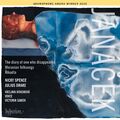
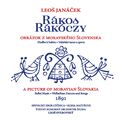
One of the greatest Czech composers, Leoš Janáček developed a highly personal style based on spoken melody and the collection of traditional songs, exemplified by his best-known works, the operas Jenůfa and Katja Kabanova. Born into a family of schoolteachers in Hukvaldy, Moravia, then part of the Austrian Empire, on July 3, 1854. He received a musical education from his father, who was also an organist and choirmaster, before continuing his education at St. Thomas's Abbey in Brno, where he joined the choir directed by Pavel Křížkovský. Although resistant to authority, the young Janáček showed himself to be a gifted musician at the piano. In 1872, he graduated as a schoolteacher, but preferred to follow a musical path, taking over the direction of the Svatopluk men's choir (1873-1877) and studying for two years at the Prague Organ School with František Skuherský and František Blažek. He met Antonín Dvořák, who commented on his early compositions and gave him advice, before forming a lasting friendship. Without a piano, he practiced by drawing a keyboard on a table, and passed the exam with top marks. Back in Brno, a city to which he would remain attached for the rest of his life, Janáček directed the Beseda Philharmonic Society from 1876 onwards, and continued his studies at the Leipzig Conservatory with Oskar Paul and Leo Grill, then in Vienna with Franz Krenn. In Brno, where he taught at the Teachers' Institute, he fell in love with the director's daughter, Zdenka Schulzová, whom he married on July 13, 1881. The couple had two children, Olga and Vladimir, who died at the age of ten and two respectively. In the same year, he founded a new organ school, which he directed until 1919, and which became the Brno Conservatory. With the help of the institute's principal, František Bartoš, Janáček went in search of traditional Moravian songs and dances, collecting tunes for publication in several collections. Appointed secretary of the Moravian Department of Folk Studies in Prague in 1885, he wrote articles for the musical journal Hudební listy and composed his first opera, Šárka (1888), which could not be staged due to author Julius Zeyer's refusal to set music to his text. Drawing on the characteristics of the folklore at his disposal and taking his cue from Smetana and Dvořák, Janáček composed the Moravian Dances (Valašské tance, 1890), followed by the ballet Rákós Rákóczy and a second opera, Počátek románu(The Beginning of a Romance, 1891). Between 1894 and 1903, he worked intermittently on a more ambitious opera, Její pastorkyňa(Their Foster Daughter), based on a play by Gabriela Preissová, in which he established his "spoken melody" style(nápěvky mluvy), drawing on the inflections of the Moravian dialect. Presented without much success in 1904 under its new title Jenůfa, the work definitively leaves the post-romantic field and the fashionable Wagnerian style to explore the depths of tonality through the use of original harmonies and complex rhythms, under the influence of the physicist Helmholtz's acoustic work on chord resonances. Rejected by the director of Prague's National Theater, the influential Karel Kovařovič, whose comic opera Ženichové Janáček had mocked, the work, which ranks among the composer's greatest achievements, enjoyed a late fame despite its difficult subject matter dealing with infanticide. Revived in a reworked version in Prague on May 24, 1916, then in Vienna in 1918, it remained off the bill for a long time before being rediscovered seventy years later. This initial lack of recognition only deepened Janáček's depression after the loss of Olga, and his marriage fell apart. A trip to Russia and a spa encounter with Kamila Urvalková in Luhačovice inspired him to write the opera Osud(Destiny, 1906). Janáček should not be seen only as a composer of vocal works, though he did strive to make the human soul perceptible. His piano pieces are also remarkable and present in the repertoire, such as the series of fifteen pieces Sur un sentier recouvert (1901-1911) or the Sonate 1.X.1905, known as "De la rue", written in reaction to the death of a Czech worker during a demonstration, then Dans les brumes (1912). His themes take a committed stance against national and social oppression, and question the place of the individual in society. He collaborated with poet Petr Bezruč on the choral works Kantor Halfar (1906), Maryčka Magdónova (1908) and 70,000 (1909). Between 1908 and 1917, he worked on a reworking of Svatopluk Čech's two-part novel Mr. Brouček's Travels to the Moon and to the 15th Century, which he used as the subject of the opera Výlety páně Broučkovy, premiered at Prague's National Theater on April 23, 1920. After a brief relationship with the singer Gabriela Horváthová, leading to a formal separation from his wife and separate lives at home, the composer met a married woman thirty-eight years his junior, Kamila Stösslová, who was to become his muse despite an affair that remained, to his great regret, at the platonic, epistolary stage. She inspired his song cycle Journal d'un disparu (1917) and two operas: Káťa Kabanová (based on Alexander Ostrovsky's play L'Orage ), premiered in Brno on November 23, 1921, and L'Affaire Makropoulos (adapted from a play by Karel Čapek), presented in the same city on December 18, 1826. Janáček's last decade of composition proves to be his most productive in every respect, coinciding with Czechoslovakia's independence. He composes the orchestral rhapsody Taras Boulba after Nicolas Gogol (1918). After retiring as director of the Brno Conservatory, but continuing to teach until 1925, he produced some of his greatest works, notably the chamber music String Quartets no. 1 after Tolstoy's Kreutzer Sonata (1923) and no. 2 "Lettres intimes " (1928), the popular opera The Cunning Little Vixen (November 6, 1924), the Sinfonietta (1926), the Glagolitic Mass for orchestra, organ, double choir and soloists (1926), and finally his last opera From the House of the Dead (1928), based on the novel by Fyodor Dostoyevsky, premiered in Brno on April 11, 1930. A cold contracted during a walk in the forest developed into pneumonia, and led to Leoš Janáček's death in the Ostrava sanatorium on August 12, 1928, at the age of 74.