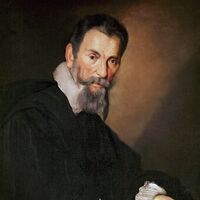
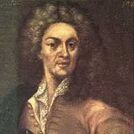
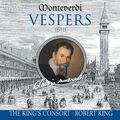
A symbol of the transition from Renaissance to Baroque, Claudio Monteverdi's attention to the musical expression of the human soul left a legacy of major works, dominated by his books of madrigals, the Vespers to the Virgin, and several seminal operas, including L'Orfeo and The Coronation of Poppea. The son of a Cremonese doctor, he was baptized on May 15, 1547, and grew up with his younger brother Giulio Cesare, who was also to become a musician. He studied singing and music theory from an early age with the choirmaster Marc'Antonio Ingegneri, who guided him in his mastery of polyphony and the organ. A precocious composer, at the age of fifteen he published a collection of twenty three-voice motets, Sacrae cantiunculae, followed by Madrigali spirituali (1583) and Canzonette d'amore a tre voci (1584). In 1587, his style became more personal in the Pimo libro de madrigali a cinque voci, published by a Venetian printer and followed three years later by a Secondo libro de madrigali, which made him even better known. After a first trip to Milan two years later, Monteverdi was engaged in 1592 at the court of the Duke of Mantua as a viola player, for a modest salary, under Vincenzo I. There, he not only made the acquaintance of the viola da gamba, but also of the viola da gamba, the viola da gamba, the viola da gamba and the viola da gamba. Here he not only met his future librettist Alessandro Striggio, but also found a master in the Flemish composer Giaches De Wert, who introduced him to the art of adjusting music to the meaning of the words of a poem, a practice Monteverdi began to put into practice in the Terzo libro de madrigali, published the same year. Serving his employer on military campaigns, he followed him to Hungary in 1595 and four years later to Flanders. When De Wert died in 1596, Monteverdi hoped to succeed him, but Pallavicino preferred him. He had to wait until Pallavicino's death, six years later, for his appointment as Kapellmeister. Meanwhile, on May 20, 1599, the composer married the daughter of a court musician, Claudia Cattaneo, who bore him three children, including a daughter who died in infancy. In 1600, he attended the premiere of Jacopo Peri's first known opera, Euridice, and in the same year came under attack from the canon Giovanni Maria Artusi, who published a pamphlet against the modernists, of whom Monteverdi was one. The composer defended himself by asserting that he was following a tradition that had simply evolved from the prima prattica to the seconda prattica. Despite the damage to his reputation, Monteverdi, appointed Kapellmeister in 1602, published his fourth and fifth collections of five-part madrigals in 1603 and 1605. The madrigal stylist, who had reached a certain plenitude in this exercise, entered new territory with the composition of an opera, L'Orfeo, premiered at the Accademia degli Invaghiti in Mantua in February 1607, which emancipated itself from Florentine recitative by integrating monody and madrigal. The same year, he was appointed to the Accademi degli Animori in Cremona, where he mourned the death of his wife on September 10. He accepted the commission to write an opera for the wedding of François de Gonzague to Marguerite de Savoie, L'Arianna, which premiered in Mantua on May 28, 1608, and of which only the poignant Lamento d'Arianna remains, a testament to his art of transcribing feelings into music. In the midst of sentimental and financial turmoil, Monteverdi was also affected by the death of the singer Caterina Martinelli, to whom he dedicated the Sestina from his sixth collection of madrigals (1614). Disappointed with his condition at the Mantuan court, he tried to obtain a position with Pope Paul V, to whom he offered a mass in the stile antico and the famous Vespro della beata Vergine(Vespers to the Virgin, 1610). When, in 1612, he was dismissed from his post by François de Gonzague, who had succeeded his father, Monteverdi was hired the following year at a more advantageous salary as Kapellmeister of St. Mark's Basilica in Venice, where he remained until his death. Busy as he was with this position and the many services it demanded, the composer devoted most of his time to sacred music, fulfilling commissions such as the ballet Tirsi e Clori (1616), for the court of Mantua. Nevertheless, he continued his quest for perfection in his important Settimo libro de madrigali, an innovative work in which monody rubs shoulders with the concerto, and which includes the Lettera amorosa (1619). His dramatic cantata Il combattimento di Trancredi e Clorinda (1624), inspired by Tasso's Jerusalem Delivered, further expresses the moods of the characters. For the court of Mantua, with Striggio's help, he produced the comic opera La finta pazza Licori (1627), whose score has disappeared, as have those of the interludes for the court of Parma and the opera Proserpina rapita, of which only a fragment survives. The plague epidemic that swept through Venice in 1630 led to the suspension of musical activities for several months, and took the life of his son Francesco. When the epidemic ended, Monteverdi composed a Mass in thanksgiving, of which only the Gloria survives. No doubt as a result, Monteverdi took Holy Orders in 1632, and in the same year wrote the last of his Scherzi musicali, the first collection of which had appeared in 1607. In 1638, he published the anthology Madrigali guerrieri et amorosi, including the famous Lamento della ninfa. At a time when the first opera houses were opening in Venice, and when his Arianna was revived in 1640, Monteverdi proved prolific, writing four works, two of which have survived the centuries: Il ritorno d'Ulisse in patria(The Return of Ulysses to his Homeland, 1640) and L'Incoronazione di Poppea(The Coronation of Poppea, 1642), considered the first modern operas for their realistic situations, characterization of characters and use of different musical parts in a continuous dramatic narrative. The sacred Selva morale et spirituale (1641), a Messe a quattro voci e salmi published posthumously in 1650, and, the following year, the ninth and final collection of madrigals, were also written between these two masterpieces. On November 26, 1643, Claudio Monteverdi, aged 76, succumbed to a devastating illness.