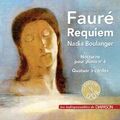
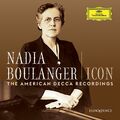
Better known as a teacher than as a composer, conductor or composer, Nadia Boulanger trained several generations of musicians and exerted a great influence on the music of her century. Born in Paris on September 16, 1887, Juliette Nadia Boulanger came from a line of musicians that included her cellist grandfather Frédéric Boulanger (1777-1844), her mezzo-soprano grandmother Marie-Julie Boulanger (1786-1850) and her composer father Ernest Boulanger (1815-1900), winner of the Grand Prix de Rome in 1835, married to the Russian singer and princess Raïssa Ivanovna Mychetsky (1856-1935). Music did not appeal to her in early childhood, until she heard a fire bell and tried to reproduce its sound on the piano. When her sister Marie-Juliette, known as "Lili", was born in August 1893, music reigned supreme at the home of friends Gabriel Fauré, who became her composition teacher at the Paris Conservatoire, Charles Gounod and Camille Saint-Saëns. Trained on the piano by her mother, Nadia Boulanger also studied the organ with Alexandre Guilmant and Louis Vierne, with classmates Charles Koechlin, Georges Enesco, Florent Schmitt, Maurice Ravel and Alfred Cortot. After two successive failures, in 1908 she won the Second Grand Prix de Rome for her cantata La Sirène. Four years later, her sister became the first woman to win the Premier Grand Prix, and was received by the President of the Republic, Raymond Poincaré. Promised an illustrious career with compositions such as the melody Clairières dans le ciel, and choral and symphonic works, Lili Boulanger died prematurely at the age of 24, on March 15, 1918, having dictated the sacred choir Pie Jesu to Nadia on her deathbed. This tragic event marked the end of composition for his elder sister, who had already written numerous vocal works, a few pieces of chamber music and the opera La Ville morte after Gabriele D'Annunzio, composed with Raoul Pugno, who died on January 3, 1914. The abandoned work, which lost much of its orchestration, was finally reconstituted and premiered on stage in 2005. After playing the organ at the Madeleine church as Fauré's substitute, Nadia Boulanger turned her attention to teaching and conducting. A piano teacher at the École normale de musique and the Paris Conservatoire, she gave private lessons in her apartment on rue Ballu, and in January 1925 premiered the Symphony for organ and orchestra dedicated to her by Aaron Copland. She conducted the London Philharmonic Orchestra in 1936, the Boston Symphony Orchestra in 1938, gave recitals and premiered the Dumbarton Oaks concerto by her great friend Igor Stravinsky. Highly respected and an authority on her extensive knowledge, "Mademoiselle" Boulanger taught at the American Conservatory in Fontainebleau from its inception in 1921, becoming its director from 1948 until her death on October 22, 1979, at the age of 92. Young musicians from all over the world flocked to receive her guidance in all areas of musical practice. Over a thousand pupils included Copland, Walter Piston, Virgil Thomson, Elliott Carter, Grażyna Bacewicz, Igor Markevitch, Jean Françaix, Lennox Berkeley, Leonard Bernstein, Dinu Lipatti, Hugues Cuenod, Michel Legrand, Quincy Jones, Dalton Baldwin, Idil Biret, Daniel Barenboim, Antoni Wit, Émile Naoumoff and many other composers and soloists. Nadia Boulanger was made a Chevalier (1932) and then a Grand Officier (1977) of the Légion d'honneur, and was also made a Commandeur de l'Ordre des Arts et des Lettres (1966), a Gold Medalist of the Académie des Beaux-Arts (1975) and a Member of the Order of the British Empire (1977).