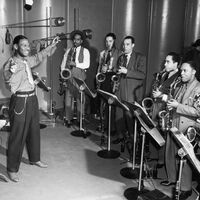
Born in Duquesne, Pennsylvania on December 28, 1903, Earl ‘Fatha’ Hines was one of the most important and influential pianists in the history of jazz. His father, Joseph, played the cornet in and, as a child, Earl looked set to follow suit until the age of nine when his mother persuaded him a to take up piano. In 1923, he relocated to Chicago, Illinois and worked with Sammy Stewart and Erskine Tate’s Vendome Theatre Orchestra. Three years later, he began a long-term collaboration with Louis Armstrong that would continue for years. Earl Hines was an exceptional soloist but also spent time as a bandleader, debuting his own big band – Earl Hines and His Orchestra – in Chicago at the Grand Terrace on December 28, 1928, his 25th birthday. For the next two decades, he led his own band that, at various times, featured some of the era’s top musicians including Walter Fuller (trumpet/vocals), Ray Nance (trumpet/violin), Trummy Young (trombone), Budd Johnson (tenor saxophonist), reed players Darnell Howard and Omer Simeon, and many others. They released a series of 10” singles including “I Love You Because I Love You”, “Blue Drag”, Harlem Lament”, “Wolverine Blues”, “Just to Be in Caroline”, “Swingin’ Down”, “That’s a Plenty”, and many more. Billy Eckstine became his most popular vocalist when he joined in 1940. During the musicians’ recording strike in 1943, Earl Hines’ band became one of the first bebop orchestras when he brought in Sarah Vaughan (vocals), Charlie Parker (tenor saxophone), and Dizzy Gillespie (trumpeter). All three members were gone by the time the strike ended, but Earl Hines still pushed forward with Wardell Gray (tenor saxophone), who played with the orchestra in 1945 and 1946. After World War II ended, the popularity of big bands waned and by 1948, facing economic hardship, Earl Hines dismantled his orchestra. He joined Louis Armstrong’s All-Stars for several years before heading up a Dixieland band. By the 1960s, Hines' popularity had faded, but he had a career renaissance in 1964 when Stanley Dance arranged three live dates for him at New York's Little Theater, thrusting him back into the limelight. For the next two decades, he continued to tour and record. Earl Hines died on April 22, 1983. Over the years, there were many compilations released that featured classic Earl Hines and His Orchestra recordings including Earl ‘Fatha’ Hines and His Orchestra (1959), Harlem Lament (1989), and Earl Hines and His Orchestra: 1932 – 1934 and 1937 (2009), and many others.