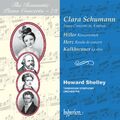
Known until recently only as Robert Schumann's muse and an accomplished pianist, one of the greatest virtuosos of the century of Chopin and Liszt, Clara Schumann was also a composer in her own right whose work is now being rediscovered. Born in Leipzig, in the Kingdom of Saxony of the German Confederation, on September 13, 1819, Clara Josephine Wieck was the second daughter of eminent piano teacher Friedrich Wieck and his pupil, soprano and pianist Mariane Wieck née Tromlitz. From the age of five, her father instilled in her a rigorous piano education, while her mother left home after an adulterous affair with a relative. To make her a first-rate concert performer, he taught her the fashionable repertoire for social success, in addition to theoretical studies and violin lessons. In March 1828, she dazzled audiences at a private concert and attracted the attention of her father's seventeen-year-old pupil, Robert Schumann. On October 20, 1828, she was just nine years old when she gave her first public performance at the Gewandhaus, the city's largest concert hall, before her first recital on November 8, 1830. In the intervening year, the Four Polonaises for piano were written. In 1831, the young Schumann moved in with the Wiecks to devote himself fully to his career as a virtuoso pianist, which was cut short by the paralysis of two fingers after intensive practice. Meanwhile, Wieck took his daughter on an extensive tour of Europe, visiting Weimar to meet Goethe and Paris to play with violin virtuoso Niccolò Paganini. Having established her reputation, Clara Wieck, exempted from school by her father, resumed her musical studies, which included sight-reading, harmony, counterpoint, composition and singing. She already had piano pieces, lieder and a Scherzo for orchestra (1831) to her credit. Her friendship with the young Schumann developed into a love affair, formalized by a marriage proposal on September 13, 1837, to which Clara's father was firmly opposed. At first, he kept the lovers apart by scheduling a tour of Germany for his daughter. From December 1837 to April 1838, she stayed in Vienna and dazzled the critics with her interpretation of Beethoven's "Appassionata" Sonata, ahead of Chopin and Liszt. The city awarded her the title of Königliche und Kaiserliche Kammervirtuosin ("Virtuoso pianist of the King's and Emperor's chambers") and the Gesellschaft der Musikfreunde, the Vienna Philharmonic Society, elected her a member. This journey gave rise to a passionate correspondence between Robert and Clara, whose father set two conditions for their union: an increase in the former's income as a composer, and their distance from Leipzig. After a court case won by the two lovers, the marriage finally took place in Schönefeld on September 12, 1840, and the couple lived in Leipzig, in an apartment with a single piano occupied by Robert, who devoted himself to composition, while Clara added only a dozen lieder to her repertoire and gave birth to two daughters, Marie and Elise, born in 1841 and 1843 respectively. Their relationship blossomed through the Journal à deux voix, in which they took turns to express themselves. In 1844, she went on a four-month tour of Denmark and Russia. On December 11 of the same year, the couple settled in Dresden, and Clara had her own music salon with piano, composing a Prelude and Fugue in F sharp minor (1845). She resumed touring, adding her husband's compositions to her repertoire, and gave birth to Julie (1845-1872), with whom Johannes Brahms fell in love; Emil (1846-1947), who died in infancy; Ludwig (1848-1899), who ended up in an asylum; Ferdinand (1849-1891) and Eugenie (1851-1938), who died nine years after the elder Marie and, like her, wrote a book of selected memories of their father. After the death of their friend Felix Mendelssohn, which affected them deeply in 1847, and the revolution of 1848, when they had to take refuge with friends in Kreischa, a position became available in Düsseldorf, where Robert Schumann was appointed musical director. The couple moved in on September 2, 1850, and their financial situation improved. Promoted to conductor, Robert Schumann conducted his Symphony no. 3 "Rhineland", but relations with the musicians deteriorated as he became unfit for the job. His health deteriorated, and he eventually delegated his post to his assistant, before resigning. Clara's support was not enough, nor was the friendship of the young Brahms, who became an intimate of the family and of violinist Joseph Joachim. Picked up by fishermen after throwing himself into the Rhine, Robert Schumann was committed to an asylum in Endenich, where he died on July 29, 1856, having seen Clara for the last time a few days earlier. A new life began for Clara Schumann, who after composing the Three Romances for piano op. 21 (1853), dedicated to her confidant Brahms, began the Romance in B minor (1856), unpublished in her lifetime. From 1857, she moved to Berlin for a few years to be closer to her mother, divorced from Wieck and widow of the pedagogue Adolf Bargiel, then to Baden-Baden for three years. She made several trips to England, where she gave concerts. From 1878 to 1892, after another five years in Berlin, Clara Schumann taught piano at the Hoch Conservatory in Frankfurt am Main. Deaf in her last years, and confined to a wheelchair, she died in the same city on May 20, 1896, aged 76. She left a total of some seventy compositions, including further piano pieces, transcriptions of her husband's lieder, a choral work 3 Gemitschte Chöre (1848) and an unfinished Piano Concerto in F minor (1847). Later came the Geburstagmarsch in E-flat major (1879) and three improvisations, the Vorspiele, Praeludium and Praeludien für Schueler, dated 1895. From the beginning to the end of her concert career, from 1831 to her last public concert in Frankfurt on March 12, 1891, Clara Schumann gave some 1,300 concerts, many of them devoted to works by her husband, Brahms, Mendelssohn and Chopin. Her work as a composer, long overshadowed by her status as a muse, or even virtuoso, was only revived at the end of the twentieth century, and recordings of her works have since become more regular.