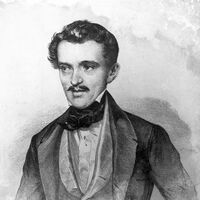
The "king of the waltz", whose famous Beau Danube bleu reigns at the top of over 500 dances, not only made Austria and Europe twirl in the 19th century, but also entertained them with operettas such as La Chauve-Souris. Son of Johann Strauss (known as Johann Strauss I, 1804-1849), he was born in St. Ulrich, near Vienna, on October 25, 1825, the eldest of two siblings, Josef and Eduard, who also became composers of light music. The father of "Schani", his childhood nickname, was a renowned composer who preferred to see him embark on a career in banking rather than follow in his footsteps, not so much out of fear of rivalry, as was widely believed, but out of fear of a precarious life as a musician. Not so the young man, who discreetly learnt piano with Wenceslas Plachy and violin with a member of his father's orchestra, Franz Amon. On the other hand, his mother, Maria Anna Streim, was very supportive of his artistic development and encouraged him. Johann Strauss Jr. was seventeen when his father, infatuated with his mistress Emilie Trampusch, left the family home in 1842. This left the teenager free to study violin with Anton Kohlmann, a coach at the Vienna Opera, composition with Joseph Drechsler, and counterpoint and harmony with Joachim Hoffmann. In 1844, when his parents' divorce was finalized, he obtained a license to give concerts and formed an orchestra of twenty-four musicians recruited from a tavern. On the bill at the Casino Donmayer in Hietzing since October 15, his program featured six of his own compositions alongside those of his father, eclipsed by his Opus 1, which included the waltzes Sinngedichte and Gunstwerber, and the polka Herzenslust. It was a runaway success, provoking the anger of a father who refused to collaborate with him, reigning supreme in Viennese musical life. So Johann Strauss II went off in search of glory, touring Europe and North America. Back in Vienna, he accepted the position of Kapellmeister of the 2nd Citizen's Regiment, then in 1848, the position of Head of the Municipal Music, while his father was working at the Austrian Court. The revolution that broke out in the capital accentuated the rivalry when the son sided with the insurgents. Arrested for playing La Marseillaise, he was acquitted just as his father played the famous Radetzky March in tribute to Field Marshal von Radetz, before dying of scarlet fever. A new era dawned for the son, who brought together the musicians of both orchestras and won the good graces of the new Emperor Franz Joseph I with the Franz-Josef Marsch (op. 67) and the Kaiser Marsch (op. 126). A prolific composer, Johann Strauss II was then in his golden age, making Viennese society dance, bringing to the popular waltz all its sophistication, rhythmic elegance and noble lyricism. Adored in the capital, he took his orchestra across Austria-Hungary, Poland and Germany, then to Paris, Berlin and London. This intense activity between writing and touring was not without risk to his health, and in 1853, suffering from a nervous breakdown, he had to leave for seven weeks' rest in the countryside, leaving his brother Josef to take his place. He easily regained his former position, and in 1855 toured Russia, visiting it every year for a decade. Author of a Tritsch-Tratsch-Polka (1858) and Perpetuum mobile (1861), a "musical joke", which proved popular with the public, Strauss II twice tried to obtain the position once held by his father, that of Director of Ball Music at the Austrian Court(Hofballmusikdirektor), which he finally obtained in 1863. This prosperous period saw the birth of some of his greatest works, such as Le Beau Danube bleu (1866), an orchestral crescendo that became the unofficial anthem of the Empire; the waltzes Vie d'artiste (1867), Histoires de la forêt viennoise (1868), Aimer, boire et chanter (1869), Les Mille et une nuits (1871) and the famous Sang viennois (1871), which is also the name of an operetta created in 1899; the polkas Vive les Hongrois!and Dans les bois de Krapfen (1869), and the fast-paced À la chasse (1875). In 1872, at the invitation of military conductor Patrick Gilmore, Strauss II travelled to Boston, USA, for the World Peace Festival, bringing together a thousand musicians to perform his famous Spring Waltz. Married to opera singer Henriette Treffz from 1862 to 1878, he began composing operettas in the style of Jacques Offenbach, with great success for his masterpiece The Bat (1874), followed by A Night in Venice (1883) and The Gypsy Baron (1885). On the death of his first wife, he immediately remarried the actress Angelika Dittirch, for a tumultuous relationship that ended in divorce four years later, in 1882. The annulment of the marriage, refused by the Church, led Strauss to convert to Protestantism, marrying Adele Deutsch for the third time in 1887, who brought him emotional stability and supported him in his last works, such as the famous Valse de l'Empereur (1889) and the operetta Waldmeister (1895), while his health declined in his last decade. After contracting pneumonia, Johann Strauss II died in Vienna on June 3, 1899 at the age of 73, leaving behind around one hundred and fifty waltzes, one hundred polkas, marches, quadrilles and sixteen operettas. Honored during his lifetime and respected by his peers Verdi, Wagner and Brahms, he influenced Franz Lehár first and foremost, but also lesser-known composers such as his namesake Richard Strauss and the twelve-tone composers Berg, Schoenberg and Webern, who transcribed waltzes for string quartet. Every year since 1939, the Vienna Philharmonic Orchestra has performed some of his works and those of his father at the New Year's Concert in the Musikverein's golden hall, an event broadcast on mondovision in 90 countries since 1958.