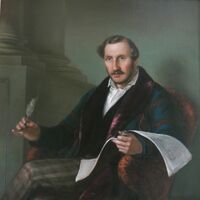
In the course of a long career in the bel canto style, Gaetano Donizetti wrote many of his operas into the repertoire, including L'elisir d'amore, Lucia di Lammermoor and Don Pasquale, to name the best-known. Born into a poor family in Bergamo on November 29, 1797, Domenico Gaetano Maria Donizetti's father, a weaver turned pawnbroker, intended him to work as a lawyer. But like his older brother Giuseppe (b. 1788), who would become a composer at the court of the Turkish sultan, he aspired to a career in art, drawing or music. At the age of eight, he entered the local music school, the Scuola caritatevole, founded by choirmaster Simon Mayr, where he studied harpsichord, harmony and singing with various teachers, before leaving in 1815 to study fugue and counterpoint at the Liceo Filarmonico in Bologna, under Father Stanislao Mattei, who was also Rossini's teacher. He worked on religious pieces, but was more assiduous with opera, and the first of these, Il Pigmalione (1816), marked the start of a long list. However, at his parents' request, he enlisted in the Austrian army and took advantage of his free time to compose. He completed his fourth opera when he was finally released from his military duties and was able to attend the staging ofEnrico di Borgogna at Venice's Teatro San Luca on November 14, 1818. Although his subsequent productions had their ups and downs, Zoraide di Granata was enthusiastically received at Rome's Teatro Argentina on January 28, 1822. Over the course of the decade, no fewer than twenty-five operas were brought to the stage, in the three fashionable genres of opera buffa, semiseria and seria. Most of his successes were in Naples, although some were premiered in Milan or Rome, as in the case of L'Ajo nell'imbarazzo (1824), none of which left a lasting impression. In 1825, Donizetti obtained the post of musical director at Palermo's Teatro Carolino, where Alahor di Granata (1826) was performed, but he only stayed for one season. On June 1, 1828, he married Virginia Vasselli in Rome. The couple moved to Naples, where the composer was appointed director of the Royal Theatres from 1829 to 1838. If he scored another success with L'esule di Roma (1828), it was the triumph of Anna Bolena, performed at Milan's Teatro Carcano on December 26, 1830, to a libretto by Felice Romani, starring Giuditta Pasta and Giovanni Battista Rubini. Donizetti's first opera to be performed in Paris, it went on to travel to London, Madrid, Dresden and even Havana. His reputation was established when he unveiled L'Elisir d'amore on May 12, 1832 at Milan's Teatro della Canobbiana, based on Eugène Scribe's libretto for Daniel-François-Esprit Auber's Le Philtre. Among its enchanting arias is the famous tenor romance "Una furtiva lagrima". Attracted by historical reconstructions, Donizetti tackled subjects such as Torquato Tasso (Rome, 1833) and Lucrezia Borgia (Milan, 1833), then turned his attention to English sovereigns with Rosamonda d'Inghilterra (Florence, 1834) and Maria Stuarda (premiered as Buondelmonte in Naples, October 18, 1834). In 1834, he was appointed choirmaster and professor of composition at the Real Collegio di musica in Naples, then master of counterpoint two years later. In 1835, at the invitation of Gioachino Rossini, the composer stayed in Paris, where Marino Faliero was staged at the Théâtre-Italien, with a cast featuring Luigi Lablache, Antonio Tamburini, G. B. Rubini and Giulia Grisi. Made a Chevalier de la Légion d'Honneur by King Louis-Philippe, he returned to Naples to attend the triumphant premiere of his most memorable work, Lucia di Lammermoor, premiered at the Teatro San Carlo on September 26, 1835. A masterpiece of bel canto in the golden age of Romanticism, the opera seria features many arias that were beloved by performers and audiences alike, including "Il dolce suono" in the famous mad scene. The death of his rival Vincenzo Bellini, which assured him supremacy in Italian theaters, was followed by that of his wife on July 30, 1837. Deeply affected, he nevertheless finished Robert Devereux (Naples, October 29, 1837), the fourth and final episode in a series devoted to the Tudor dynasty, which was a great success from Europe to New York and Buenos Aires. Donizetti's disappointment at not being appointed to succeed Zingarelli as head of the Conservatory, and problems with the censorship of Poliuto, led him to leave Naples for Paris, where the opera, based on Corneille's Polyeucte, was premiered in French under the title Les Martyrs, to a libretto by Eugène Scribe, on April 10, 1840. Prior to this, on February 11 of the same year, La Fille du régiment was staged, a military comedy with the perilous "Ah! mes amis quel jour de fête!", nicknamed "L'Everest des ténors" with its nine counter-cuts. December 2 saw the performance of La Favorite, a grand opera in four acts which, although not an immediate success, nevertheless established itself in the repertoire, as did Linda di Chamounix (1842), first performed in Vienna, where it was honored by the imperial court, and then in Paris. On January 3, 1843, he enjoyed his last great triumph with Don Pasquale, featuring Lablache, Tamburini, Giulia Grisi and Mario. Donizetti returned to Vienna for the premiere of Maria di Rohan (1843), then completed Dom Sébastien, roi du Portugal (Paris, 1843). Caterina Cornaro, the last opera to be created during his lifetime, was performed at the Teatro San Carlo in Naples on January 18, 1844, while Rita ou le mari battu was premiered posthumously in 1860. Afflicted by syphilis, the composer also suffered from nervous fatigue, slurred speech and impaired mobility. In 1846, suffering from insanity, he was committed to an insane asylum in Ivry, then transferred to Paris and brought back the following year by his nephew to Bergamo, where he died on April 8, 1848, at the age of 50. In addition to seventy-two operas, Gaetano Donizetti left thirteen symphonies, eighteen string quartets, three quintets, a horn concerto, twenty-eight cantatas and around one hundred and fifteen sacred pieces, including a Requiem dedicated to Bellini (1835) and numerous other works.